
NACS vs J1772: Choosing the Right Home EV Charger Connector in Yorba Linda
J1772 and NACS solve the same job at a Level 2 outlet, but they fit different vehicles. Here is how to match the connector to what is actually parked in the driveway in Yorba Linda -- today and next.
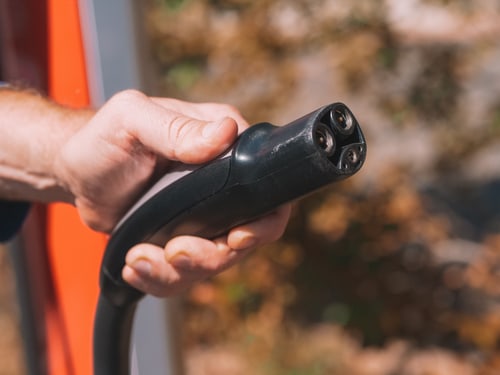
NACS vs J1772 is the first decision most Yorba Linda homeowners run into once they start shopping for a Level 2 home charger, because the connector on the wall has to match the inlet on the vehicle sitting in the driveway. J1772 is the long-standing standard that most non-Tesla EVs have used for over a decade. NACS, short for the North American Charging Standard, is the connector Tesla designed and that a growing list of other automakers are now building into new vehicles. Neither one is universally better -- the right choice depends on which vehicles are actually charging in the garage, this year and a few years from now.
J1772 Is the Charging Standard Most Non-Tesla EVs Already Use
J1772 is the SAE-standard connector used for AC Level 2 home charging by the large majority of electric vehicles sold in the United States that are not built by Tesla. It is the plug on the end of the charging cable for brands like Chevrolet, Ford, Hyundai, Kia, Nissan, and most other non-Tesla EVs on the road today, and it is what nearly every third-party Level 2 home charger has shipped with for years. According to the Alternative Fuels Data Center, charging infrastructure is expected to be compliant with SAE International standards such as SAE J1772, which is why the connector shows up on hardware from dozens of different manufacturers rather than one brand's proprietary design.
For a home install, J1772 charging runs on a 240-volt circuit, the same voltage tier the Alternative Fuels Data Center describes for Level 2 equipment, which is the setup nearly every home charger installer in Yorba Linda is running today. If every vehicle in the household is a non-Tesla EV, a J1772 charger is usually the simplest, most future-proof purchase, since it plugs in without an adapter and works with the next non-Tesla EV the household buys too.
NACS Is the Tesla-Designed Connector Automakers Are Now Adopting
NACS, the North American Charging Standard, is the compact charging connector Tesla designed for its own vehicles and has more recently opened up for other automakers to build into new EV models. It's the plug used on Tesla's own home charging hardware, including the Tesla Wall Connector, which the company says is compatible with most electric vehicles, not only Teslas, and can deliver up to 11.5 kW and 48 amps of output on a home circuit. Tesla notes the Wall Connector's lightweight design supports either indoor or outdoor mounting, which matters in Yorba Linda, where a good number of garages sit detached or set back from the main electrical panel.
For a homeowner who drives a Tesla, or plans to replace a current EV with one of the newer non-Tesla models built with a factory NACS inlet, a NACS home charger is the straightforward match. The core rule Tesla gives buyers still applies either way: confirm the charger's plug matches the vehicle's charging inlet before ordering hardware, since a mismatch means paying for an adapter or buying the wrong equipment outright.
NACS vs J1772: How the Two Connectors Compare for a Home Install
The two connectors solve the same basic job -- delivering 240-volt Level 2 power to a parked EV -- but they differ on a handful of concrete points that actually matter once real hardware gets ordered.
- Vehicle match: J1772 fits nearly every non-Tesla EV on the road; NACS fits Tesla vehicles and the newer non-Tesla models built with a factory NACS inlet.
- Charger hardware: J1772 chargers are sold by dozens of manufacturers; Tesla's own Wall Connector is a NACS charger rated up to 11.5 kW and 48 amps, and third-party NACS chargers are becoming more common.
- Adapters: a household with a mixed fleet, one Tesla and one non-Tesla EV, can often use an adapter to charge either vehicle on either connector, though the buyer should confirm adapter compatibility for the specific charger and vehicle before relying on it daily.
- Certification: whichever connector is chosen, the ENERGY STAR label marks chargers that have been safety-tested by a nationally recognized lab, since ENERGY STAR notes that not every charger sold is safety certified.
- Mounting: indoor or outdoor mounting is available on many Level 2 chargers regardless of connector, including Tesla's Wall Connector, which is rated for either location.
Both connector standards are mature enough at this point that neither is a bad technical bet -- the real difference for a homeowner is which one already matches the vehicle in the garage, not which one is newer.
Adapters Bridge a Mixed-Connector Household, But They're a Workaround
Adapters exist precisely because many households end up running more than one EV over time, and they let a single charger serve both a NACS vehicle and a J1772 vehicle in a pinch. The trade-off is convenience: an adapter is one more piece of hardware to keep track of, plug in correctly, and store somewhere dry in the garage, and it doesn't change the charger's rated output -- a J1772 charger adapted to a NACS vehicle still delivers whatever the J1772 side is rated for. For a household that expects to keep a mixed fleet indefinitely, that's a fine permanent setup. For a household about to replace its only non-Tesla EV with a Tesla, or the reverse, it's worth planning the home charger around where the fleet is headed rather than just where it sits today.
Which Connector Matters for a Yorba Linda Home Install
Southern California Edison is the utility serving Yorba Linda homes, and the connector choice itself has no bearing on the utility side of the project -- the 240-volt circuit, breaker sizing, and panel capacity work the same whether the charger at the other end is J1772 or NACS. What does change is the hardware quote: a Level 2 EV charger installation built around a J1772 charger is the standard path for a non-Tesla household, while a Tesla Wall Connector installation is the direct route for a Tesla-only household that wants the connector built for the car.
Anaheim Hills, Placentia, Brea, and the rest of north Orange County share the same mix of older panels and newer, larger ones that Yorba Linda has, so the practical starting point in either case is the same: confirm what's actually parked in the driveway today, ask what's realistically coming next, and let that answer, not brand loyalty to one connector, decide the charger.
Not Sure Which Connector Fits Your Driveway?
Tell us what's parked in the garage today, and what might be there next, and we'll spec a Level 2 or Tesla Wall Connector install that matches -- no guessing required.
Instant QuoteNACS vs J1772: Future-Proofing Your Home Charger
More automakers building NACS inlets into new EVs doesn't mean J1772 disappears from Yorba Linda driveways any time soon -- the installed base of non-Tesla EVs already on the road, plus every used EV sold for years to come, keeps J1772 relevant well into the next vehicle-replacement cycle. The more useful question for a homeowner buying hardware today is whether the charger itself is easy to live with later: a hardwired Level 2 charger with a widely supported connector and a documented adapter path costs less to keep useful than one built around a connector standard that turns out to be a dead end for the next vehicle in the household.
ENERGY STAR-certified, networked chargers use roughly 40% less energy in standby mode than uncertified models -- worth checking on the spec sheet regardless of which connector a household lands on.
Frequently Asked Questions About NACS and J1772 Home Charging
Do I need a NACS or a J1772 home charger?
It depends on what's parked in the driveway. A non-Tesla EV needs a J1772 charger; a Tesla, or a newer non-Tesla EV built with a factory NACS inlet, is the direct match for a NACS charger like Tesla's Wall Connector.
Can a J1772 charger work with a Tesla?
Yes, with the adapter Tesla vehicles have shipped with for years -- a Tesla can charge on a J1772-equipped Level 2 charger using that adapter, which is one reason a J1772 charger remains a practical, connector-agnostic choice for a household that might add a Tesla later.
Will NACS eventually replace J1772 completely?
Not on a timeline that affects a charger bought today. Automakers are adding NACS inlets to new models, but the large existing fleet of J1772 vehicles on the road, plus every used EV sold in the years ahead, keeps J1772 relevant for a long transition period.
Does NACS charge faster than J1772 at home?
Not inherently -- both are Level 2, 240-volt connectors, and the charging speed comes down to the charger's rated output and the vehicle's onboard charger, not the connector shape. Tesla's own Wall Connector, for example, tops out at 11.5 kW and 48 amps, a spec comparable to higher-output J1772 chargers on the market.
Should I choose a hardwired charger or one with a plug?
Either can work with either connector standard; the choice mostly comes down to garage layout and whether the household expects to relocate the charger later. A licensed electrician can size the circuit and recommend hardwired versus plug-in based on the panel and the specific charger chosen.